A built-in cooler has no air behind it, so it must vent at the front. All three picks state a front vent, fit the common 15-inch cabinet gap at 34 to 34.3 inches tall, and were in stock on Amazon.com on October 29, 2026.
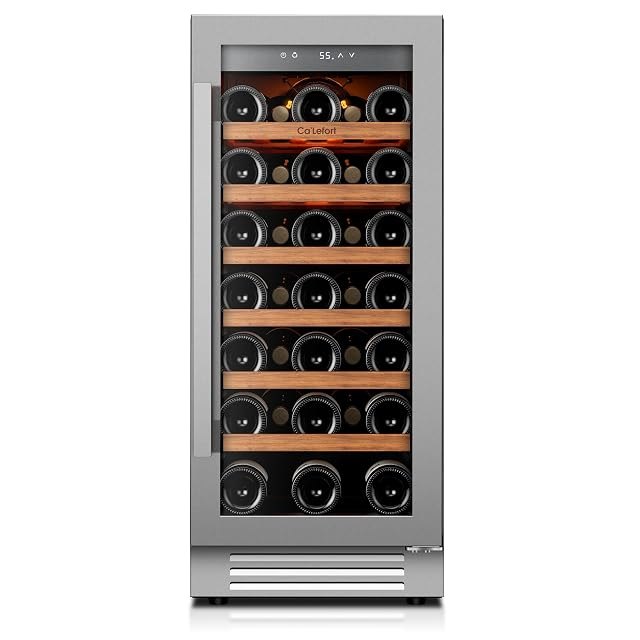
The Ca’Lefort CLF-WS15-A holds at least 33 bottles at 40–65 °F in 1 °F steps, with a compressor, a fan and a front vent for built-in, under-counter or freestanding use. It is the only 15-inch unit here with a published weight (85 lb) and a warranty broken down into the machine, the parts and the compressor. About $480.
The same figures for less
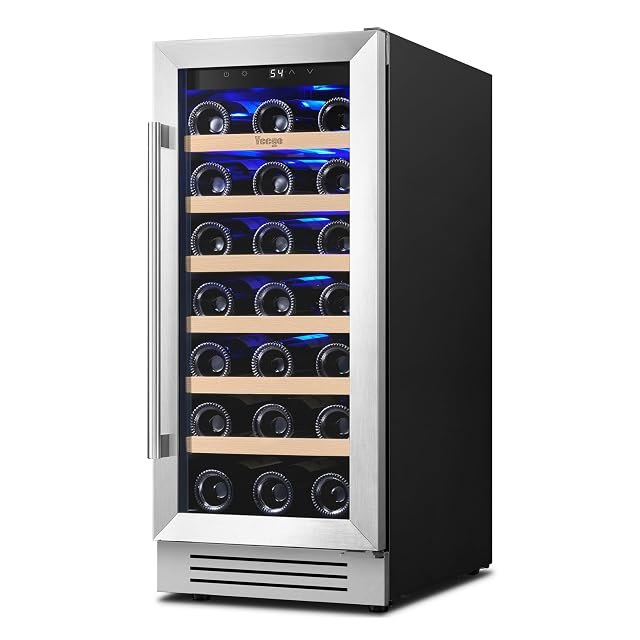
The Yeego 15-inch publishes exactly the same dimensions (14.8 × 22.4 × 34 in), capacity, shelf count, range and power-failure memory as the Ca’Lefort. It gives no weight and no warranty term. About $385.
Two zones under a counter
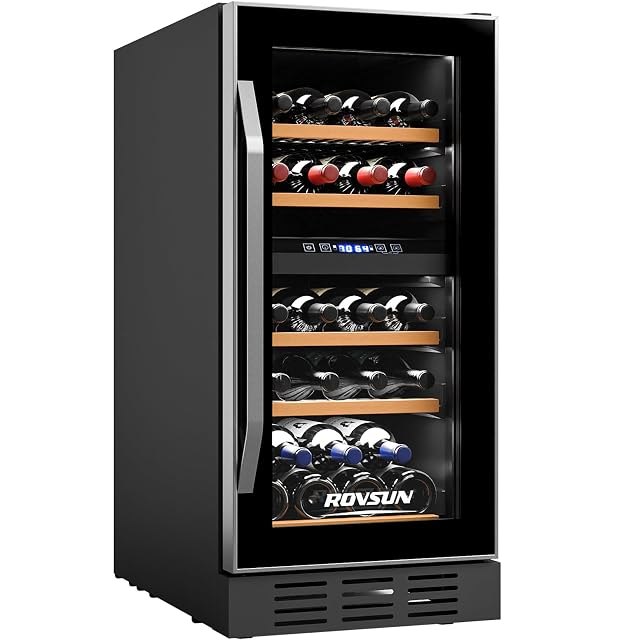
The ROVSUN 15-inch is the only dual-zone model in this width: 26 bottles, both zones at 41–64 °F to within 1 °F, beech shelves, front vent. One field of its spec table says “freestanding”; the bullets describe the front-venting built-in design. About $340.
What we would not do
Install any of them with the front grille behind a kick plate or a cabinet door. Front venting only works if the front can breathe.
Which cabinet suits your collection?
You are fitting the cabinet under a worktop
You need a model explicitly rated for building in, which sheds its heat at the front.
You have an enclosed niche
Built-in is mandatory: a freestanding cabinet enclosed will overheat and stop holding temperature.
You want a front flush with the kitchen
Look at whether the door reverses and whether a panel can be fitted: not every model allows it.
You have no permanent niche
A freestanding cabinet costs less and can move; built-in earns its place when the cabinetry is already there.
Picking by what you store
Fitted kitchen
The main use: filling a standard kitchen bay. Dimensions and hinge side matter more than anything else.
Island or bar
The appliance is seen from all sides: front finish and interior lighting then matter as much as the cooling.
Under stairs or in a recess
Clearances become critical, and you must check the warm air has a way out.
Daily service
A cabinet at worktop height is more accessible than a tall one, and that often decides whether it is actually used.
The few numbers that decide it
Front venting
That is what separates a built-in from a freestanding unit. Without it, an enclosed appliance rejects heat into its own housing and runs endlessly.
Exact niche dimensions
Width, height, depth, but also hinge position and door swing. A door fouling an upright makes the cabinet unusable.
Hinge side
Reversible or not: in a kitchen, a door that opens the wrong way kills the use. It is checked before ordering, not after.
Noise, in an open kitchen
Built in, the appliance is closer to people and sound reflects off the cabinetry. The quoted level is felt more than in free standing.
Which number for which collection
Your installation
What it takes
The risk
Under a worktop, front clear
A built-in model
A freestanding one that overheats
Enclosed niche
Built-in plus a vent
Heat with nowhere to go
Island seen all round
Careful finish and lighting
A mismatched front
Temporary position
A freestanding cabinet
A built-in bought for nothing
The traps to dodge
Building in a freestanding model
The commonest and costliest mistake: it overheats, uses more, stops holding setpoint and ages fast. The difference is ventilation, not size.
Measuring the niche without the plinth
A few millimeters decide. Usable height is measured including the plinth, and adjusting the feet does not make up for everything.
Forgetting the cable run
A socket badly placed behind the appliance stops it going fully home, or worse, crushes the cable. The supply point is planned with the niche.
Ignoring the door swing
In a kitchen, a wall or an upright nearby can limit opening to an angle that stops you drawing the shelves out.
By the kind of host you are
The new kitchen
A built-in of standard dimensions, reversible door, matched front. The format then gives its best.
The refit
Measure the existing niche first, then look for a model: the other way round leads to disappointment.
The tight budget
A well-ventilated freestanding cabinet gives the same service; building in is a choice of integration, not of performance.
Care, servicing and how long it keeps going
A built-in cabinet is harder to reach, and that is exactly why it gets neglected. The front grille collects dust, and clogging it strangles the ventilation, which is the only route out for the heat.
Dust the front grille regularly: it is the vital point of a built-in.
Draw the appliance out of its niche once a year where the design allows.
Check the door seal, worked harder when the front is closely fitted.
Make sure nothing has been pushed behind the cabinet during building work.
Safety
A heavy appliance slid into a niche, often fitted single-handed.
Fit with two people: weight and bulk make it risky alone.
Provide a socket reachable without moving the appliance.
Never block the front grille, even temporarily.
Check the housing unit is stable before sliding a loaded appliance into it.
Prices quoted in this text were read on October 29, 2026. The live price is at the top of the page.
33 bottles · 1 zone · 40–65 °F · compressor and fan · front vent · 85 lb
A 15-inch front-venting compressor cooler for at least 33 bottles, 40 to 65 °F in 1 °F steps, with sapele-wood shelves and a warranty that separates the machine, the parts and the compressor.
Best for: A 33-bottle under-counter install where the warranty matters as much as the price
33 bottles · 1 zone · 40–65 °F · compressor · front vent · 14.8 in wide
A 15-inch front-venting compressor wine cooler for 33 bottles, built in or freestanding, 40 to 65 °F in 1 °F steps, with six wooden shelves and power-failure memory.
Best for: Filling a 15-inch gap under a kitchen counter with 33 bottles at one temperature
Can a freestanding cooler be built in to save money?
No. Freestanding coolers vent at the back or sides. Boxed into cabinetry they cannot shed heat, run constantly and fail early. Look for "front vent" in the listing, as on all three picks here.
Will a 34-inch cooler fit under my counter?
A standard US counter is about 36 inches high with a 34.5-inch opening below. The Yeego and the Ca’Lefort are 34 inches and the ROVSUN 34.3, so all three fit with little to spare: measure your own opening.
Are the Yeego and the Ca’Lefort the same cooler?
Their listings agree on every published dimension, capacity, shelf count, temperature range and feature. That points to one factory. The Ca’Lefort adds a published weight and a warranty broken down by part.
Can I have two zones in 15 inches?
Yes, the ROVSUN, at the cost of seven bottles: 26 against 33.
What must stay clear after installation?
The grille at the bottom of the front. It is the cooler’s only air path once the sides and back are enclosed.
Spares and fittings from the same aisle, at the price we noted. Check they match the cabinet you choose before you order: it depends on the model and the part number, which the listing states.
Dawselod 47.2-Inch Wall-Mounted Wine Rack · Wine racks & shelving — 47.2-inch wall-mounted wine rack, solid wood and thickened iron, rated 100 kg (220.5 lb)/220 lbs, 7.87 in wide, guardrail, plug-in LED strip, concrete or wooden walls only · $179
Homeiju 20-Bottle Freestanding Wine Rack · Wine racks & shelving — Freestanding wine rack, 20 bottles and 9 glasses, metal frame with thickened MDF, dustproof and waterproof leather drawer, adjustable foot, numbered parts · $85
Every cabinet here comes from the catalog this site keeps. Specifications are those the manufacturer states and those printed on the Amazon listing; prices are the Keepa reading for the date below, and both change. Ranking rests on declared specifications, on stated strengths set against stated limits, and on price. No item here has been used in person, and nothing on the page suggests it has.