Skip to content

The best built-in wine cellars for 2026

A built-in cellar is fitted flush into cabinetry with no clearance behind it, which means it must exhaust heat out the front — a genuinely different design from a freestanding cooler that vents from the back or top and would overheat if boxed in the same way. This is the single detail that trips up buyers who assume any wine cooler can go under a counter. We compare front-venting confirmation against the maker's own installation guidance, cabinet dimensions against standard kitchen cutout sizes, bottle capacity, and noise — since a built-in unit sits closer to where people actually spend time than a cooler tucked in a garage.

The models we recommend

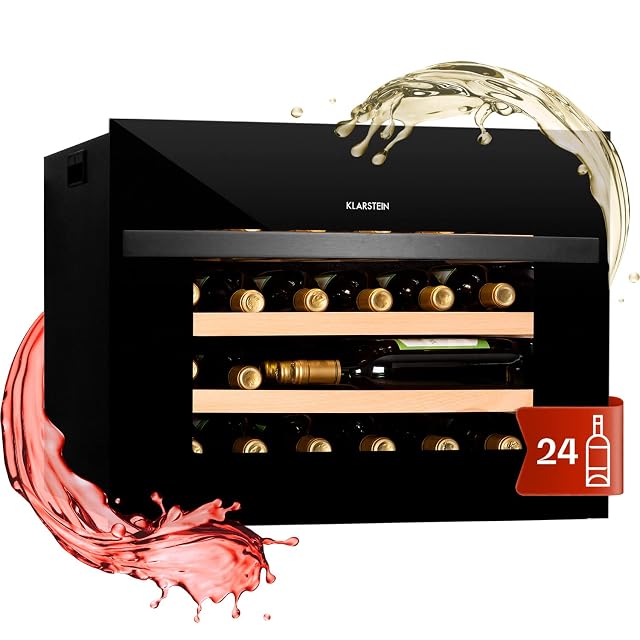
  1. Klarstein Klarstein 24-bottle built-in wine cellar

    24 bottles · 1 zone · 51 L · tilting door

    A smaller built-in cooler for 24 bottles with a tilting door design rather than a standard hinge, and a 51-liter single-zone cabinet. Confirmed live with a real price on Amazon.fr; not confirmed present on the German listing checked.

    Best for: A smaller kitchen or bar installation that wants genuine built-in wine storage without the footprint or cost of a 40-plus-bottle unit.
    7.8/10

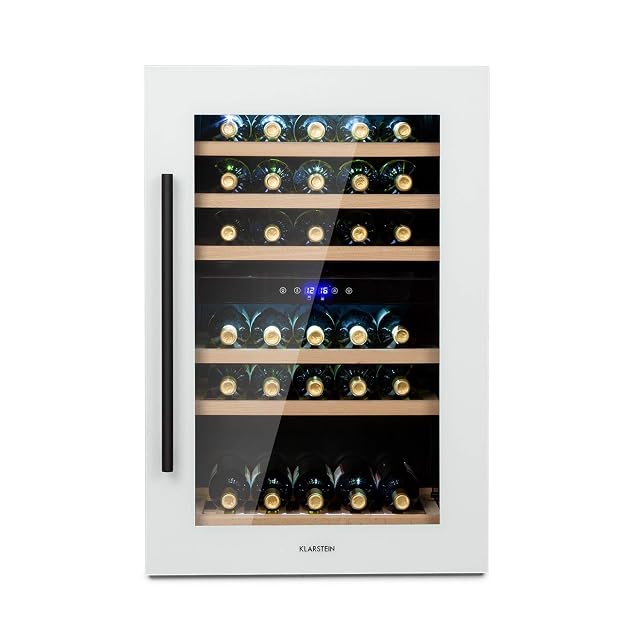
  2. Klarstein Klarstein Vinsider Duo Quartz built-in wine cooler, 41 bottles

    41 bottles · 2 zones · 5–22 °C (41 to 72 °F) · built-in, front-vented

    A built-in dual-zone cooler for 41 bottles with a QuartzCrystal-framed glass front, spanning a 5–22 °C (41 to 72 °F) range across two zones. Confirmed live with a real price on Amazon.de; not confirmed with a live price on the French listing checked.

    Best for: A household with the budget and cabinetry space for a genuine built-in, two-zone cooler at real capacity — including outdoor installations.

    8.4/10

The need before the model, across built-in wine cellars

Fitting a reserve into the kitchen

A built-in is calculated on the available recess and on what it can hold. Capacity is what decides between two models of the same width.

Klarstein Vinsider Duo Quartz

Fitting the recess to the millimeter

A built-in fit turns on three dimensions and the ventilation gap, and one centimeter too many means rebuilding the unit. The stated built-in dimensions are compared with the measured recess, not with the neighboring cabinet.

Klarstein Vinsider Duo Quartz

Who buys what, across built-in wine cellars

Fitted kitchen
A built-in blends into a run of units and is worked out like an appliance, not like something you move around.
Under a worktop
Standard recess heights govern the choice. A few millimeters decide whether the unit goes in or not.
Renovation
The electrical supply and the recess ventilation are planned before fitting. Making up for it afterwards is far more expensive.

Nothing is free: the trade-offs of built-in wine cellars

Integration against ventilation
A built-in must vent at the front, which limits the usable models. Fitting a rear-vented cabinet into a closed recess makes it overheat and fail.
Fixed dimensions against capacity
The recess fixes the available volume. The only remaining variable is the efficiency of the interior racking.
Hinge against opening
The opening direction must suit the way people move through the kitchen. Not every door is reversible.

Buyers’ questions on built-in wine cellars

Can any cabinet be built in?

No. Only front-venting models can go into a closed recess. A rear-vented cabinet built in overheats.

How do I measure the recess?

Usable width, height and depth, plus the clearances the maker requires. Those clearances are part of the dimension; they are not negotiable.

Does a built-in wine cellar need its own socket?

A socket reachable without dismantling the unit, at the stated position. That is what most often gets forgotten in a renovation.

Is the door reversible?

On many models, yes, but not all. Check before fixing the kitchen layout.

Is a built-in cabinet noisier?

The cabinetry can act as a soundboard. A decoupled mounting limits the transmission of vibration.

Can it go next to an oven?

That is inadvisable without insulating separation: the neighboring heat drives the compressor continuously.

Do I need a vented plinth?

On an under-counter built-in, air must be able to circulate at the front. A solid plinth blocks the venting.

Can a built-in cooler be used free-standing?

Yes, though not the other way round: a model designed for building in vents at the front and works in the open too. A free-standing model placed in a recess overheats.

What to take away from built-in wine cellars

Only front-venting models can be built in: a rear-vented cabinet in a closed recess overheats and fails. The required clearances are part of the dimension, and the socket is planned before fitting, not after.