Skip to content

The best dual-zone wine cooler for 2026

All three hold reds and whites at separate temperatures in one cabinet. What differs is how precisely each brand documents the split between zones, and how much capacity you get for the price.

The straightforward step up

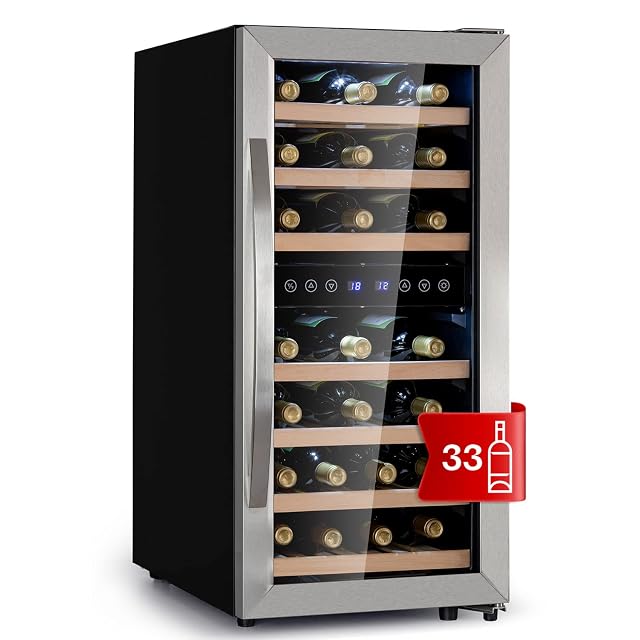
The Klarstein 33-bottle cooler is first for anyone moving up from a single-zone model without needing a documented per-zone split — its 5–18 °C (41 to 64 °F) combined range and UV-protective glass door are confirmed live with real stock on all four EU markets checked.

The only cooler that documents its split

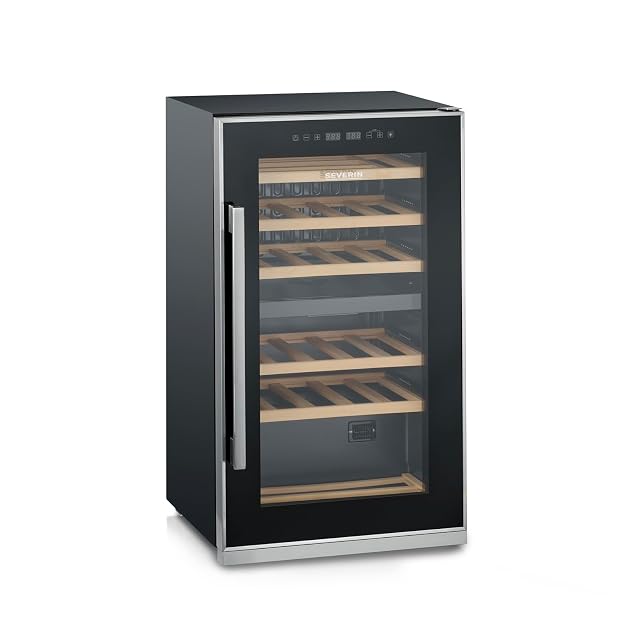
The Severin SEVINZO 28 Duo is the pick if a genuinely confirmed temperature split matters, not just a “dual zone” marketing line. It’s also the only cooler in this trio with double glazing on the door and a published 41 dB noise figure — at a real price premium.

Maximum capacity, with added features

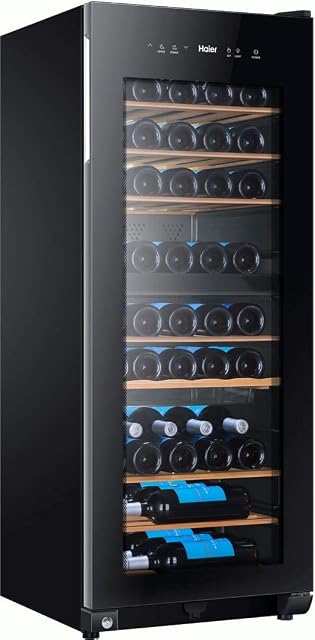
The Haier WS53GDA holds 53 bottles — the most of any dual-zone cooler reviewed on this site — and adds a carbon filter and anti-vibration construction neither rival states. It doesn’t publish a per-zone split, so treat “dual zone” here as confirmed independent zones without a documented range for each.

What we would not do

Assume every “dual zone” cooler splits its range the same way. Only the Severin states its per-zone figures directly — for the Klarstein and Haier coolers, the two zones are confirmed independent, but exactly where each one sits within the stated range isn’t published.

Which cabinet suits your collection?

You drink both whites and reds
That is the point of the format: two compartments set separately, with no single compromise.
You mostly keep one kind of wine
A single-zone cabinet of the same size costs less and often offers more usable volume.
You want a real gap between zones
Check the maker publishes each zone's range and not one overall range: many do not.
Space is tight
A dual zone is taller or deeper for equal capacity, because of the partition and the second circuit.

Picking by what you store

Serving two colors at table

The obvious use: a chilled white and a red at drinking temperature with no planning. It is what a single zone cannot do.

Separating service and keeping

One zone at drinking temperature, the other cooler and steady for resting. A practical compromise in a home with no cellar.

Entertaining often

The capacity of the zone you use most becomes the real criterion: an unbalanced split forces you to mix.

Sparkling wine

It is served cooler than still whites. A lower zone able to come down far enough becomes necessary.

The few numbers that decide it

The real gap between zones
The central criterion and the most often glossed over. Two zones separated by a simple vented partition hold only a small gap, and the spec sheet stays silent.
How the volumes are split
Many models divide unevenly. If you mostly drink red, a large cold zone is of no use to you.
The number of compressors
Some models regulate two zones with one refrigeration circuit, others have two. Stability and noise follow directly.
The climate class
As with any cabinet, it says in what ambient the appliance keeps its promises. Outside its class, the coldest zone gives way first.

Which number for which collection

What you wantWhat to checkThe trap
Whites and reds togetherEach zone's rangeA single overall range quoted
A real gapInsulation between zonesA vented partition
Usable capacityHow volumes are splitA large zone you will not fill
StabilityThe number of refrigeration circuitsOne compressor for two zones

The traps to dodge

Buying dual zone for one kind of wine
The format costs more, offers less usable volume and complicates racking. If you drink one color, single zone is better on every count.
Believing the zones are independent
On many models the upper zone partly depends on the lower. Adjusting one moves the other, which the manual rarely mentions.
Loading one zone and emptying the other
An empty compartment regulates badly and makes the appliance cycle. The wine itself provides thermal mass.
Ignoring depth
A dual zone is often deeper than a single zone: under a worktop, a few centimeters decide feasibility.

By the kind of host you are

The household that entertains
Two well-split zones, comfortable capacity, and a model that publishes its ranges separately.
Everyday service
A modest dual zone is enough: the point is the gap, not the volume.
The undecided
Count the bottles actually drunk by color over a year. The answer is almost always in that number.

Care, servicing and how long it keeps going

A dual zone has twice the opportunity to drift: two sensors, sometimes two fans, and a partition where condensation gathers. Maintenance is the same as a single zone, with one extra check.

  • Check both zones hold their setpoint with an independent thermometer.
  • Clean the partition and internal grilles, where damp lingers.
  • Dust the condenser, worked harder than on a single zone.
  • Check both door seals on twin-door models.

Safety

The same precautions as a standard cabinet, with an appliance that is often heavier.

  • Wedge or fix the appliance, especially loaded and on sliding shelves.
  • Let it stand upright before first switching on after transport.
  • Dedicated socket, no extension lead.
  • Respect clearances: a twin circuit sheds more heat.

Our choices, and what drove them

  1. Klarstein Freestanding 33-bottle dual-zone wine cooler

    33 bottles · 2 zones · 5–18 °C (41 to 64 °F)

    A 33-bottle freestanding cooler with two independently set temperature zones across a 5–18 °C (41 to 64 °F) range, UV-protective glass and interior LED lighting. Same ASIN and EAN confirmed live on Amazon.de, .fr, .it and .es.

    Best for: A household wanting to store reds and whites at genuinely different temperatures in one cabinet, with more headroom than an 8- or 12-bottle single-zone cooler.
    7.8/10

  2. Severin SEVINZO 28 Duo dual-zone wine cooler

    28 bottles · 2 zones (5–12 °C (41 to 54 °F) / 12–18 °C (54 to 64 °F)) · 41 dB

    A 28-bottle, 80-liter dual-zone cooler with a stated upper zone of 5–12 °C (41 to 54 °F) and lower zone of 12–18 °C (54 to 64 °F), touch control, double glazing and wood shelving. Same ASIN and EAN confirmed live on Amazon.de, .fr, .it and .es.

    Best for: A household that wants a specific, confirmed temperature split between zones — not just 'dual zone' as a marketing line — and is prepared to pay a premium for it.

    7.8/10

  3. Haier WS53GDA

    53 bottles · 2 zones · anti-UV glass · carbon filter · 40 dB

    A 53-bottle freestanding dual-zone cooler with anti-UV glass, a carbon filter, anti-vibration construction and a door lock. The same ASIN and EAN are confirmed live on Amazon.de, .fr, .it and .es.

    Best for: A household that has outgrown a smaller dual-zone cooler and wants meaningful capacity plus the quieter, carbon-filtered build this model states, at a price to match.

    8.4/10

What readers ask us

Which cooler actually publishes its per-zone temperature split?

Only the Severin SEVINZO 28 Duo does, stating an upper zone of 5–12 °C (41 to 54 °F) and a lower zone of 12–18 °C (54 to 64 °F). The Klarstein and Haier coolers publish only a combined range for both zones together.

Is 53 bottles too much for a first dual-zone cooler?

It's the largest option here, and it comes with a real footprint and price to match — worth it only if the collection already needs that much space. For a first dual-zone cooler, the 28- or 33-bottle options are a more proportionate step up from a single-zone model.

Can the upper zone be set colder than the lower?

Rarely: cold air falls, and most models are built with the coldest zone at the bottom. Forcing the reverse gives unstable gaps.

Do two zones use twice the energy?

No, but a little more than a single zone of the same volume, because a gap must be held between neighboring compartments. The gap you ask for matters more than the number of zones.

How many bottles does a cabinet quoted at fifty really hold?

Fewer, as soon as formats vary: Burgundy and Champagne bottles are wider. The quoted figure assumes one format racked as tightly as possible.

Should I take the shelves out to gain space?

You gain volume and lose access: without shelves, every bottle at the back means moving those in front. On a service cabinet that soon grates.

Can a dual zone serve as an aging cabinet?

Partly: temperature is adjustable, but humidity is rarely held. For a few years it passes; beyond that it is a different appliance.

Why does the upper zone not come down far enough?

Often because it shares a circuit with the lower one, and the gap asked for exceeds what the partition allows. That is a design limit, not a fault.

Each cabinet, and the collection it fits

Klarstein Weinkühlschrank Freistehend 33 Flaschen

Made for: A household wanting to store reds and whites at genuinely different temperatures in one cabinet, with more headroom than an 8- or 12-bottle single-zone cooler.

Where it wins: Two independently set zones across a genuinely wide 5–18 °C (41 to 64 °F) span, covering sparkling wine through to reds

Where it loses: Klarstein's listing does not state whether the two zones run on a shared compressor or independent circuits — a shared circuit with a baffle can let some thermal bleed happen between zones

Read the full review →

Severin SEVINZO 28 Duo

Made for: A household that wants a specific, confirmed temperature split between zones — not just 'dual zone' as a marketing line — and is prepared to pay a premium for it.

Where it wins: One of the few coolers in this family with a specific, per-zone temperature split actually stated (5–12 °C (41 to 54 °F) and 12–18 °C (54 to 64 °F)) rather than a single combined range

Where it loses: Availability fluctuated across markets at the time of checking, with prices reflecting an older data point on at least one comparator site — confirm current stock and price directly before buying

Read the full review →

Haier WS53GDA

Made for: A household that has outgrown a smaller dual-zone cooler and wants meaningful capacity plus the quieter, carbon-filtered build this model states, at a price to match.

Where it wins: 53-bottle capacity, the largest freestanding dual-zone cooler confirmed for this comparison

Where it loses: At around 550 € this sits well above the entry- and mid-tier dual-zone coolers in this family, in line with its larger capacity

Read the full review →

What goes with it

Spares and fittings from the same aisle, at the price we noted. Check they match the cabinet you choose before you order: it depends on the model and the part number, which the listing states.

If you want it in a sentence

How this page was put together

Every cabinet here comes from the catalog this site keeps. Specifications are those the manufacturer states and those printed on the Amazon listing; prices are the Keepa reading for the date below, and both change. Ranking rests on declared specifications, on stated strengths set against stated limits, and on price. No item here has been used in person, and nothing on the page suggests it has.

Last checked on

Prices quoted in these summaries are dated readings. The live price is shown next to each product.

The tool we use ourselves

Chosen your tool? Now buy it at the right price.

Wine coolers and built-in cellars swing by fifty dollars or more across the year, and the biggest "discounts" often land at prices the same model sold for six weeks earlier. UniverTrack tracks the real price history across retailers, spots fake reductions, and alerts you when it is genuinely the moment to buy.

Real price historyBuy-now alertsAI buying assistant
Try free for 14 days →
No commitment · Cancel in one click · 5 languages