Skip to content

The best beverage fridge for 2026

These range from a tiny, near-silent office fridge to a genuine household beverage fridge with real can capacity. Pick by where it's going and how much it needs to hold, not by brand alone.

The smallest, quietest, cheapest option

The H.Koenig MFX230 is first for the tightest spaces — a desk, a small office — at 23 liters and a stated 23 dB, the quietest and cheapest fridge in this comparison. Its reversible door helps it fit tight installations either side.

A larger, styled step up

The H.Koenig TOAD8 adds capacity (31 L against 23 L) and vintage cream styling, at a similarly near-silent 24 dB, for a real price premium over the MFX230.

Real household capacity

The TRIUMPHKEY 90L fridge is the pick for genuine household or small-bar use — up to 128 cans behind a glass door, and the only beverage fridge in this comparison confirmed live with real pricing on all four EU markets. It doesn’t publish a noise figure, unlike its smaller H.Koenig rivals.

What we would not do

Buy a small H.Koenig mini-bar expecting household-scale capacity, or the TRIUMPHKEY expecting the near-silent operation of the smaller units. Match the fridge to the room and the volume actually needed.

Which cabinet suits your collection?

You mostly keep cans and bottles to drink cold
A standard beverage fridge is enough: it goes lower than a wine cabinet, and that is what you want from it.
You want to keep wine in it too
Careful: these appliances often go too low and regulate less finely than a cabinet. Wine does not survive long in one.
It goes in an office or a bedroom
Noise becomes the main criterion, and thermoelectric models regain the advantage.
You are putting it in a garage
Check the climate class: many small appliances stop regulating properly below a certain ambient.

Picking by what you store

Living-room bar

Varied drinks, frequent opening, a visible front. Glass door and lighting are part of the use.

Office

Small capacity, continuous running, a demand for quiet. Thermoelectric makes sense there.

Extending the main fridge

Offloading bulky drinks. Here only capacity counts, and the consumption of a second appliance must be accepted.

Stock for entertaining

Intermittent and intense use: how fast it recovers after a big load becomes the sensitive point.

The few numbers that decide it

The temperature it reaches
A beverage fridge aims lower than a wine cabinet. That is an advantage for beer and soft drinks, a drawback for wine.
The interior layout
Fixed shelves, can racks, clear height: what decides the genuinely usable volume, often far below the quoted liters.
Noise
Compressor or thermoelectric: the second is silent but depends on ambient. In a living space that choice decides everything.
The door
Glass to see, solid to insulate. On an appliance opened often, double glazing noticeably changes consumption.

Which number for which collection

What you storeWhat it takesWhat not to do
Beer and soft drinksA beverage fridgeA wine cabinet, which will not go low enough
Wine over timeA wine cabinetA beverage fridge, too cold
BothAn appliance with separate zonesA single compromise
Bedroom useQuiet thermoelectricA compressor starting at night

The traps to dodge

Keeping wine in one for years
These appliances go too low, regulate coarsely and manage no humidity. The cork dries and the wine oxidizes.
Trusting the liter figure
Fixed racks and shelves cut usable volume sharply. The quoted can count says more, provided it matches your formats.
Pushing it against the wall
Like any refrigeration machine it sheds heat. With no clearance it uses more and ages faster.
Installing it in an unheated garage
Below a certain ambient, many appliances stop triggering the compressor, and the inside follows the room temperature.

By the kind of host you are

The home bar
Glass door, lighting, comfortable capacity. The appliance is as much part of the décor as of the service.
The office
A small quiet model, accepting it will not go very low if the room is warm.
The large family
A second appliance of decent capacity, accepting the extra consumption of one more cold point.

Care, servicing and how long it keeps going

A beverage fridge suffers most from frequent opening: condensation, local frosting, a hard-worked seal. The condenser gathers dust as on any cold appliance, and that is what raises consumption most.

  • Dust the condenser, at the back or underneath.
  • Wipe condensation off the seal and the sill after heavy use.
  • Defrost as instructed if the model is not frost-free.
  • Clean the inside without scented product, which taints opened cans.

Safety

The usual precautions for a domestic cold appliance.

  • Let it stand upright after transport before plugging in.
  • Dedicated socket, no extension lead: the compressor has a starting inrush.
  • Do not put glass bottles in the freezer compartment of a combined model.
  • Wedge the appliance if it is tall and narrow with a loaded door.

Our choices, and what drove them

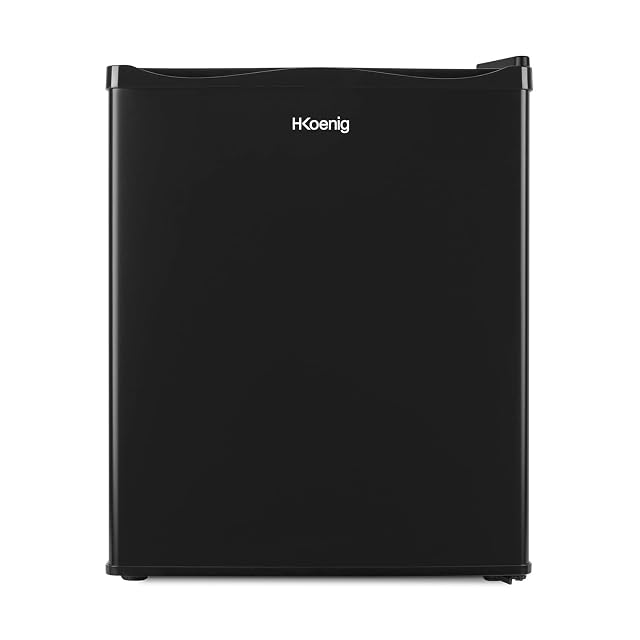
  1. H.Koenig H.Koenig Mini Bar Compact 23L

    23 L · 5–15 °C (41 to 59 °F) · 23 dB · reversible door

    The smallest and quietest beverage fridge confirmed in this comparison, at 23 liters with a stated 23 dB noise level and a reversible door for either-side installation. Confirmed live with a real price on Amazon.fr.

    Best for: The tightest spaces — a desk, a small office, a guest room — where any beverage-fridge capacity is welcome and near-silent operation and door-side flexibility matter most.
    7.2/10

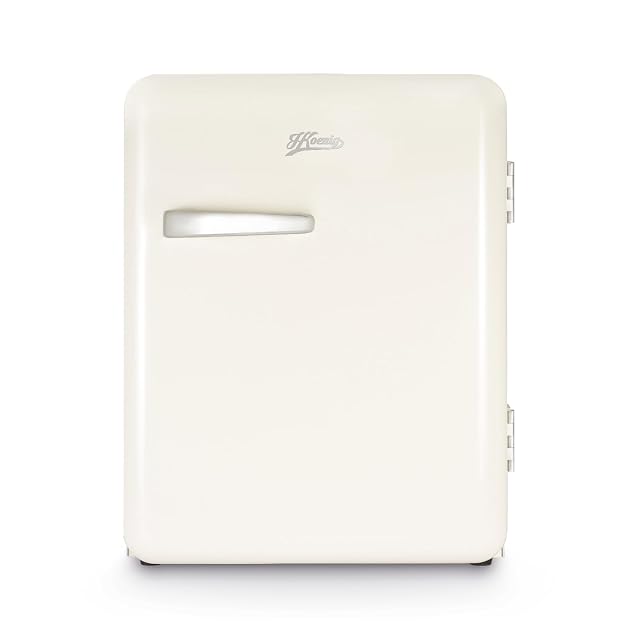
  2. H.Koenig H.Koenig Mini Bar Vintage 31L

    31 L · 6–15 °C (43 to 59 °F) · 24 dB · vintage design

    A compact 31-liter mini-bar fridge in a vintage-styled cream cabinet, with an adjustable 6–15 °C (43 to 59 °F) range and a stated 24 dB noise level. Confirmed live with a real price on Amazon.fr; not confirmed with a live price on the DE listing checked.

    Best for: A bedroom, office or small space where near-silent operation and vintage styling matter more than large capacity.

    7.2/10

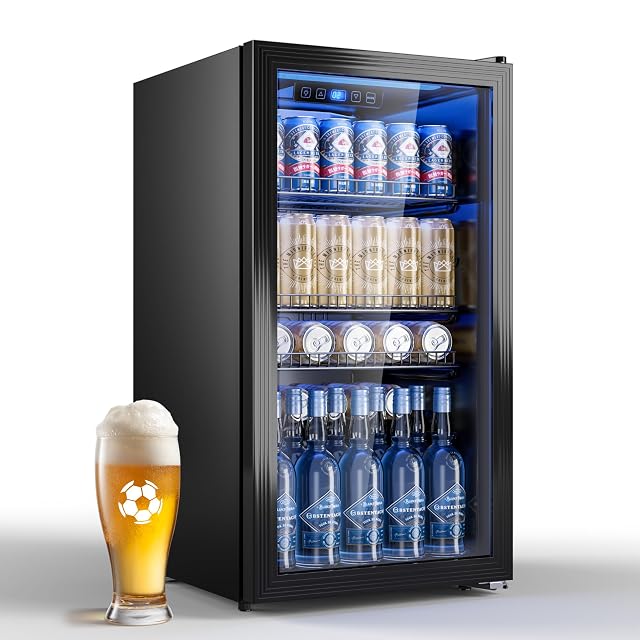
  3. TRIUMPHKEY 90L Glass Door Beverage Fridge

    90 L · up to 128 cans · glass door · adjustable shelves

    A 90-liter beverage fridge holding up to 128 standard cans behind a glass door, with adjustable shelving for beer, wine and soda. The only beverage fridge in this comparison confirmed live with real pricing on all four EU markets checked.

    Best for: A household or small home bar that wants meaningful beverage capacity with visible glass-door storage, and values confirmed availability across the EU over an established brand history.

    8.4/10

What readers ask us

Are the H.Koenig mini-bars suitable for wine?

Not specifically — both are marketed for general food, drinks and cosmetics storage with a wider temperature range than a dedicated wine cooler targets. For wine specifically, see the single-zone wine coolers reviewed elsewhere on this site.

Which fridge is the quietest?

The H.Koenig MFX230, at a stated 23 dB — among the quietest appliances confirmed across this entire site, suited to a bedroom or office where noise matters most.

Can I keep wine in one for a few weeks?

Yes, with no real harm, provided you do not run it too cold. It is long keeping that causes trouble, not temporary storage.

Thermoelectric or compressor?

Thermoelectric is silent and vibration-free but only pulls down a limited amount below ambient. A compressor goes lower and holds better, at the cost of noise.

How much does a second cold appliance use?

It depends on its size, its insulation and the room it stands in. A small appliance in a warm room can use as much as a larger one in a cool room.

Is a glass door worth it?

It is practical and decorative, and it insulates less than a solid door. On an appliance opened often, convenience generally makes up the difference.

Why does condensation form on the glass?

When room air is warm and humid, cold glass condenses. That is physics, not a fault; double glazing and a less humid room reduce it.

Can it be built in?

Only if the model is designed for it, with front ventilation. The others must stay free-standing with clearance at the back.

Each cabinet, and the collection it fits

H.Koenig MFX230

Made for: The tightest spaces — a desk, a small office, a guest room — where any beverage-fridge capacity is welcome and near-silent operation and door-side flexibility matter most.

Where it wins: 23 dB is the quietest published figure across every beverage fridge in this comparison

Where it loses: 23 L is the smallest capacity in this comparison — a handful of cans and a couple of bottles at most

Read the full review →

H.Koenig TOAD8

Made for: A bedroom, office or small space where near-silent operation and vintage styling matter more than large capacity.

Where it wins: 24 dB is one of the quietest published noise figures across every appliance reviewed on this site, suited to a bedroom or office

Where it loses: Marketed broadly for food, drinks and cosmetics rather than beverages specifically — not a dedicated wine or beer fridge

Read the full review →

TRIUMPHKEY 90L Glass Door Beverage Fridge

Made for: A household or small home bar that wants meaningful beverage capacity with visible glass-door storage, and values confirmed availability across the EU over an established brand history.

Where it wins: Same ASIN and EAN confirmed live with real stock and pricing on all four EU markets checked — the strongest cross-market result found among beverage fridges researched

Where it loses: No published temperature range or noise figure on the listings checked, unlike the smaller H.Koenig mini-bars in this family

Read the full review →

If you want it in a sentence

Pairings worth a look

One against one, already written up, for two cabinets from this guide or this aisle.

How this page was put together

Every cabinet here comes from the catalog this site keeps. Specifications are those the manufacturer states and those printed on the Amazon listing; prices are the Keepa reading for the date below, and both change. Ranking rests on declared specifications, on stated strengths set against stated limits, and on price. No item here has been used in person, and nothing on the page suggests it has.

Last checked on

The tool we use ourselves

Chosen your tool? Now buy it at the right price.

Wine coolers and built-in cellars swing by fifty dollars or more across the year, and the biggest "discounts" often land at prices the same model sold for six weeks earlier. UniverTrack tracks the real price history across retailers, spots fake reductions, and alerts you when it is genuinely the moment to buy.

Real price historyBuy-now alertsAI buying assistant
Try free for 14 days →
No commitment · Cancel in one click · 5 languages