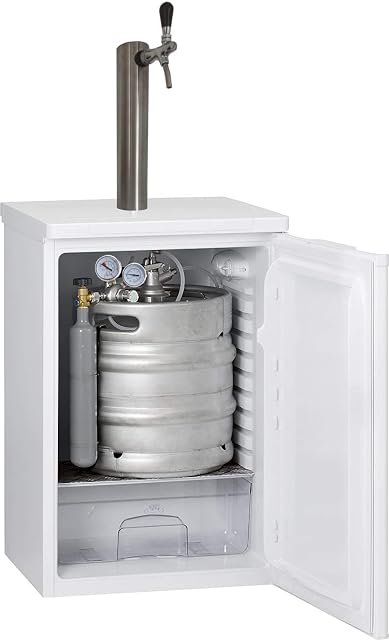
Confirm the coupler before anything else
Check the coupler type your local brewery or keg supplier actually uses — commonly Sankey (D-system) or one of several European variants — before assuming any kegerator’s included coupler fits.
Attach the regulator correctly
The regulator connects between the CO2 supply and the keg, controlling the pressure that pushes beer through the line. A loose or improperly seated connection is the most common source of a leak or a failed pour, more often than a fault with the keg itself.
Purge air from the line on first use
A new setup often has air trapped in the beer line, which shows up as excess foam on the first pour or two. Running a small amount of beer through before serving typically clears this.
Match small capsules to compact systems, large cylinders to real volume
Small threaded CO2 capsules suit occasional use or compact dispensers; a large refillable cylinder like a 2 kg (4.4 lb) tank makes more sense for a kegerator running through genuine volume regularly.
What we would not do
Assume any CO2 source and coupler will work with any kegerator. Confirm compatibility on both fronts — coupler type and regulator fitting — before the keg arrives, not after.
What readers ask us
What is a keg coupler, and why does it matter?
It's the fitting that connects the gas and beer lines to the keg's valve. Coupler types — commonly Sankey/D-system in the US, and A, S or G-system variants across parts of Europe — are not interchangeable, and a mismatched coupler simply won't seal properly.
How do I know what pressure to set the regulator to?
This depends on the specific beer style and keg — most kegerator and regulator manufacturers publish a starting pressure range, and the brewery or keg supplier can often confirm the right setting for their product specifically.
Last reviewed 25 August 2026